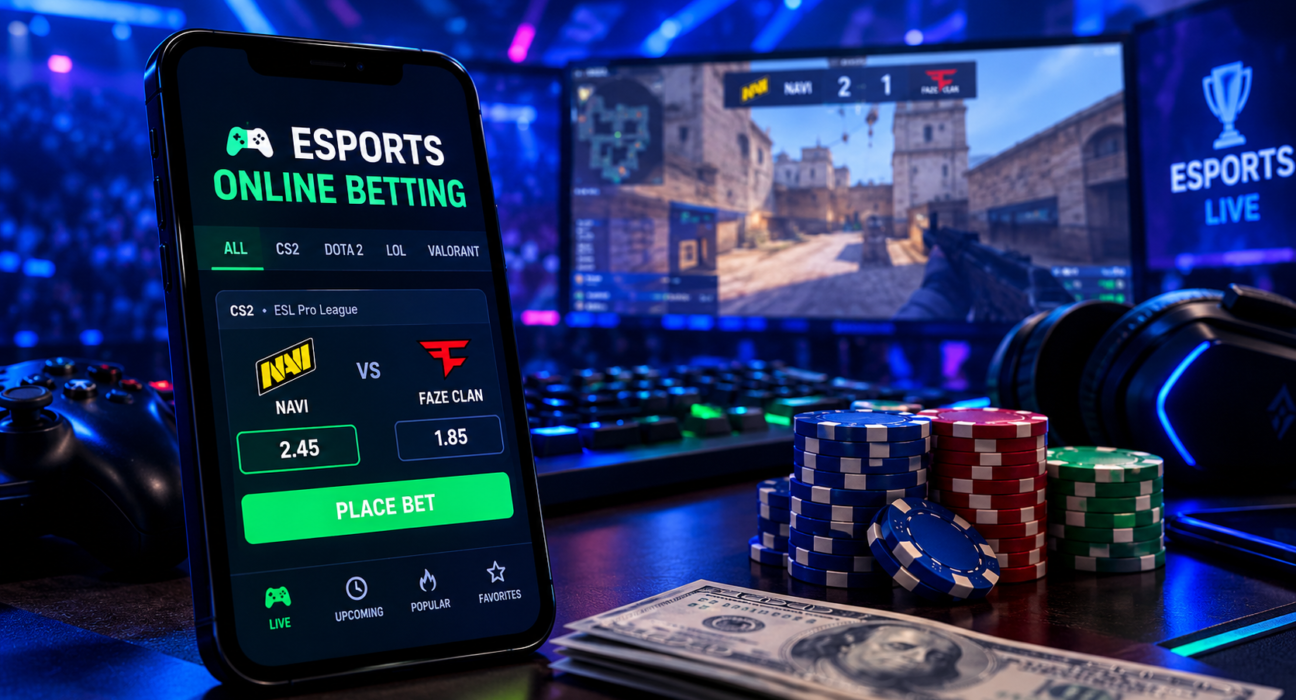
The convergence of esports and iGaming is creating one of the most interesting intersections in the digital entertainment economy. Esports bring a highly engaged, digitally native audience; iGaming brings monetization, payments, odds, risk management and global distribution.
Between them sits an increasingly valuable layer of date. The opportunity is already measurable. Statista projects the global esports market to generate $4.91 billion in revenue in 2026 with esports betting alone representing approximately $2.80 billion making betting the largest revenue segment in its market.
The wider esports market is projected to reach $6.12 billion by 2031 while users are expected to approach 931.65 million.
For investors, however, the important question is not simply whether esports betting will grow. It is who will capture the economics of that growth and who will carry the risk.
The Data Is the Product
Esports is unusually attractive to betting business because competition happens inside a digital environment that produces vast amounts of structured information. Player performance Lills, assists, rounds, maps, objectives, historical results, team strategies and live match states can all become inputs into pricing models.
This creates opportunities for pre-match, live and increasingly granular betting markets. The numbers are already showing commercial momentum. Oddin.gg’s 2025 review, based on activity across its international partner network, recorded year-on-year betting volume of 30% for Counter-Strike 2, 315 for Dota 2, 46% for League of Legends and 18% for VALORANT. Mobile Legends: Bang Bang, included in the report for the first time, recorded 62% growth in betting volume and 41% growth in bet count.
That last figure is equally important for emerging markets.
Mobile esports potentially remove one of the traditional barriers to participation: expensive gaming hardware. Where smartphones are the primary digital device, mobile titles can become the gateway through which gaming, streaming and betting converge.
Africa Could Be a Particularly Interesting Market
Africa should not simply copy the European or North American esports betting model. Its opportunity is likely to be mobile-first, payments-driven and heavily dependent on localization. The commercial signals are already appearing. In August 2026, DATA.BET announced a partnership with South African operator Hollywoodbets to provide an esports betting ecosystem including odds feeds, bet builders, widgets, streaming and managed risk and trading services. The offering covers more than 770 markets across 30+disciplies and over 10,000 events per month, including major titles such as CS2, Dota 2, VALORANT and League of Legends.
This is strategically significant.
It demonstrates that esports betting in Africa is moving beyond an experimental product category. Technology suppliers are increasingly providing the infrastructure that allows established sportbooks to enter the market without building the entire esports trading operation themselves.
For investors, that means the opportunity may not sit exclusively with bookmakers. The potentially valuable businesses are also the companies providing data, odds, streaming, trading, risk management, integrity monitoring, payments and customer acquisition infrastructure.
The Publisher Problem
There is, however, a structural difference between esports and conventional sports that investors cannot ignore. In football, basketball or tennis, no single video-game publisher owns the sport itself. In esports, publishers can exercise enormous control over the game, competition rules, intellectual property and commercial rights. EA’s current Pro rules provide a useful example.
EA reserves all commercial and media rights associated with its competition, prohibits competitors from betting on competition matches and restricts gambling and wagering companies from sponsorship of competitors in connection with the competition.
That creates an important investment question:
Who actually controls the asset being monetized?
A bookmaker may control the customer relationship. An odds provider may control trading technology. A data company may control the information. A tournament organizer may control the competition. However, the publisher may ultimately control the underlying intellectual property. This makes esports betting a more complicated ecosystem than simply putting another sport on sportbook.
The Biggest Risk Is Integrity
Growth without integrity infrastructure is not sustainable. Esports has characteristics that can create particular integrity vulnerabilities, fragmented tournaments, lower-tier competitions, digital communication and players who may operate within relatively immature professional structures.
The Esports Integrity Commission has therefore developed a specific Gold Standard for Betting-Related Esports products, covering areas including venue security, surveillance, communications, anti-cheating measures, contracts, background checks, referee training, player incentives and suspicious betting monitoring.
The broader sports market demonstrates why this matters. Sportradar reported monitoring more than one million sporting events across 70 sports in 2025, identifying 1,1116 suspicious matches. More than 99.5% of monitored events were free from suspicious activity demonstrates why monitoring becomes more important as betting increases.
For esports, integrity is therefore not simply a regulatory cost. It is commercial infrastructure. Companies capable of identifying abnormal betting patterns, detecting manipulation, securing data and protecting competitions could become strategically important as the market scales.
The Investment Opportunity Is Bigger Than Betting
The most interesting investment thesis is that esports betting should not be viewed simply as another sportbook vertical.
It is an ecosystem.
The value chain potentially runs from:
Publisher→Tournament Organiser→Data Provider→Odds/Trading Technology→Sportbook→Payments→
Every layer creates commercial opportunities. Data providers can sell information, trading companies can price markets, streaming companies can increase engagements, payment providers can facilitate transactions, integrity companies can protect the ecosystem and operators can monetize the audience. That diversification makes the sector more interesting from an investment perspective.
However, investors should also resist the temptation to equate audience growth with profitability. Esports has already experienced periods of aggressive investment, expensive events and challenging economics. The winners are likely to be businesses with scalable infrastructure and recurring revenues rather than companies dependent purely on expensive physical events or speculative audience valuations.
Esports may provide iGaming with its next major digital audience but the companies that capture the greatest value may not be the companies taking the bets. They may be the companies building the infrastructure that makes those bets possible, measurable, secure and trustworthy.