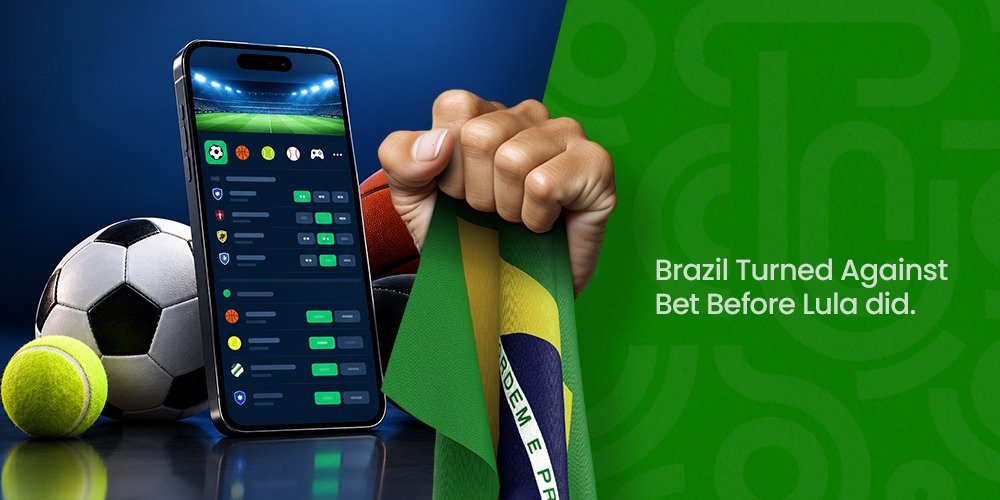
For the Betting industry, it is tempting to make Luiz Inacio Lula da Silva the villain of Brazil’s betting story. The narrative is simple: Lula came after the industry; politicians followed him and a market that investors had spent years building was suddenly put on the chopping block. But that version is too convenient.
Lula did not create Brazil’s hostility toward betting. He walked into it.
By the time the Brazilian government intensified its assault on bets, public opinion had already turned sharply against the industry. In January 2024, Dataholfa found that 55% of Brazilians are already opposed to online betting. By November, opposition had climbed to 65%, while only 27% supported keeping the market. The same survey found that 71% opposed betting advertising. This matters because it changes the story. Lula may have signed the political and regulatory hammer but Brazilian society had already supplied much of the pressure behind it.
On September 25, 2026, Lula’s government went further, issuing a provisional measure that prohibits the exploitation, offering, intermediation and advertising of fixed-odds betting-covering both sports betting and online games, including activities authorized at state and district level. So, why so many Brazilians were against betting will be discussed in details.
Brazil’s Betting Backlash Predates Lula’s Latest Offensive
The evidence is difficult to dismiss. Datafolha’s November 2024 survey found that 65% of Brazilians supported banning online sports betting. Among people who never bet, opposition was even stronger. Only 18% of current bettors supported prohibition, demonstrating an obvious divide between users of the product and the broader population. The public perception of the product was overwhelmingly negative. Datafolha found that 84% had a negative image of bets and online casino games. Fifty-four percent described them as an addiction while another 30% saw them primarily as a waste of money. Only 14% had a positive perception.
This was not Lula’s rhetoric. It was public opinion.
By May 2026, Datafolha found that the proportion of Brazilians describing bets and online games as addictive had increased from 54% in 2024 to 57%. Brazil’s betting crisis was already a social problem before it became a presidential problem.
The Industry Became Too Visible to Hide Its Consequence
Brazil’s betting market grew at extraordinary speed. However, rapid commercial growth has a dark side: it makes the consequence impossible to ignore. Betting moved into football, television, social media, mobile phones and everyday conversation. Operators competed for visibility. Advertising became ubiquitous. Betting became associated with clubs, competitions, influencers and digital entertainment. Datafolha found that social-media advertising was the most commonly cited way Brazilians encountered bets and online casino games at 32%, followed by television advertising at 11%.
That commercial strategy helped build the market. It also helped build the backlash.
The World Health Organization (WHO) has warned that the commercialization and digitalization of gambling are driving normalization and aggressive promotion through sport and social media can increase gambling activity. The WHO also identifies financial distress, mental-health problems, relationship breakdown and other harms associated with gambling.
The lesson is brutal:
The more aggressively an industry inserts itself into people’s lives, the more visible its failure become.
The Money Was Not Just Lost. It Was Coming From Somewhere
Datafolha found that among Brazilians, who currently bet or had previously bet, 35% had at some point compromised their finances to gamble in its May 2026 research. 19% had used savings, 11% had sacrificed another purchase, 10% has used a credit card, 8% had borrowed money and 6% had failed to pay a bill in order to bet. The 2014 survey was even more revealing.
Forty-eight percent of those who had bet online acknowledged at least one financial problematic behavior connected with gambling. This is the point where the industry’s argument about consumer choice becomes considerably more complicated.
Yes, adults choose whether to gamble.
However, a market becomes politically vulnerable when consumers begin reporting that gambling is competing with savings, household purchases, debt repayments and essential spending. The Brazilian government has now made that concern central to its public-health argument. According to Brazil’s Health Ministry, more than 28 million Brazilians had gambled in 12 months preceding a 2023 survey, with 10.9 million showing a pattern classified as risky or problematic.
The ministry also says SUS healthcare attendance related to pathological gambling and betting problems increased by about 140% between 2018 and 2025. These numbers do not prove that every bettor is harmed. It demonstrates something more important:
The harm was large enough to become a public-health problem.
Lula Did Not Invent the Argument. He Inherited it.
It is impossible to establish from polling alone that Lula’s motivation was purely political. His government has explicitly framed the crackdown around household debt, addiction and public health. There is also evidence that the government had built harm reduction infrastructure before the September prohibition.
In August 2026, the Brazilian government announced that the public health system would provide up to 100,000 telehealth consultations per month for people experiencing mental-health problems associated with betting. So, this is not simply a president waking up and deciding that betting is politically inconvenient. But there is another undeniable fact.
Lula moved into a political environment in which opposition to betting was already widespread.
The 2024 Datafolha figures were available long before the September 2026 prohibition. That leaves an important question:
Was Lula leading public opinion or was he responding to it?
The evidence points to a president acting in a political environment where the public had already become deeply skeptical of betting.
Lula and the Brazilian State Cannot Escape Their Own Responsibility
Brazil did not discover gambling yesterday. The state deliberately created a regulated framework. The Finance Ministry built an authorization system. Operators invested. Technology companies-built infrastructure. Sports organizations entered sponsorship agreements. Advertisers developed campaigns. Investors deployed capital.
And then the state changed the risk equation. Reuters reported that Brazil had 188 authorized betting operators and that the government collected nearly R$10 billion in licensing fees and taxes from the sector in 2025. Reuter also reported that the government estimated Brazilians spend approximately R$ billion annually on betting.
That creates a serious policy contradiction.
If betting was dangerous enough to prohibit, why was the market allowed to become so economically significant under a regulatory system created by the state?
That question cannot be answered by blaming operators alone.
Regulators approved them.
Government collected revenue.
Businesses invested.
Sport took sponsorship money.
Technology providers-built systems around the legal market.
Brazil effectively told investors that the market could be regulated.
Now the state is telling them that the social cost has become unacceptable. That is not merely a gambling story. It is a regulatory risk-story.
The Bigger Danger Is What Happens Next
That end of the legal market does not necessarily mean the end of demand. That is the next question Brazil must confront. If people continue wanting to gamble, where does that demand go?
The legal market provides:
- Identity verification;
- Payment controls;
- Responsible gambling tools;
- Monitoring;
- Taxation;
- Regulatory oversight;
- Consumer complaints mechanisms.
An illegal or offshore market may provide considerably less. The WHO has specifically warned that online gambling can remain accessible even were prohibited and that unlicensed providers can offer gambling products outside regulatory controls. A government can remove gambling from the regulated market without necessarily removing gambling from society. That does not mean Brazil’s policy will inevitably produce a larger grey market. It means that the government now has to demonstrate that prohibition can suppress demand without simply relocating it beyond the regulatory perimeter.
The Betting Industry Should Stop Blaming Lula
The industry’s instinct will be to blame Lula. That misses the bigger question.
The market lost public confidence before it lost its political protection.
When 65% of Brazilians told Datafolha they wanted online sports betting prohibited, the industry’s political vulnerability was already enormous. When 71% opposed betting advertising, the warning was even clearer. When consumers reported using savings, borrowing money and failing to pay bills to gamble, the problem became harder to dismiss as ordinary entertainment. And when the public-health system began responding to gambling-related harm, the argument had moved beyond taxation and commercial regulation. It had become a health issue.
Brazil’s Warning to Africa
African gambling markets are expanding rapidly. Operators are investing in technology, payments, marketing, sponsorships and local partnerships.
However, Brazil offers a blunt warning:
A gambling license is not a social license.
An operator can be legal still become politically toxic.
A market can generate billions and still lose public support.
Government can collect taxes from gambling while simultaneously facing pressure to restrict it.
And investors can discover that regulatory permission today does not guarantee political tolerance tomorrow.
The smartest lesson from Brazil is therefore not that governments should ban betting.
Nor is it that governments should protect the industry.
It is that market growth without credible player protection becomes a political liability.
Lula simply found himself holding the hammer when the pressure was already built.
That may be the most important warning Brazil has delivered to the global gambling industry.
You can buy market share. You can buy sponsorships. You can buy advertising. You can build technology. You can even buy a license.
What you cannot buy indefinitely is public opinion.