MTN, Airtel and ISPs Battle for Nigeria’s Broadband Market
BY Olaide Adebimpe
September 25, 2026
0
Comments
778 Views
Nigeria’s broadband market is entering a more competitive phase as traditional internet service providers (ISPs) accelerate fibre and wireless deployments, while mobile network operators (MNOs) expand into the fixed broadband market with high-speed home internet solutions.
Established ISPs such as Spectranet and Starlink continue to build their subscriber bases. As of June 2026, Spectranet remained Nigeria’s largest ISP with 111,384 active subscribers, followed by Starlink with 98,642 and FiberOne with 56,486. Across the market, total ISP subscribers stood at about 420,000.
However, MNOs are increasingly challenging traditional ISPs by deploying fibre-to-the-home (FTTH) networks and fixed wireless solutions.
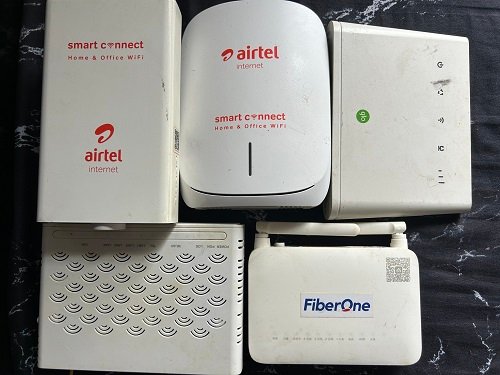
Airtel and MTN ODUs
MTN Nigeria is expanding its fibre-to-the-home offering through FibreX, while Airtel Nigeria has introduced 5G-capable outdoor units (ODUs) that can deliver high-speed home broadband without requiring the extensive underground fibre installation associated with conventional fixed networks.
MTN has also entered the ODU segment with its FlyX broadband solution, giving consumers another wireless alternative for home connectivity.
By leveraging their existing mobile infrastructure, extensive customer bases and distribution networks, MTN and Airtel can deploy broadband services across areas that may be difficult or costly for traditional ISPs to reach. Their approach also allows them to compete on installation speed, hardware deployment, network coverage and pricing.
MTN’s FibreX has attracted growing interest since its rebranding in early 2025. The service offers speeds of up to 1Gbps, unlimited data and low latency, targeting use cases ranging from gaming and cloud services to remote work and smart-home applications.
Data from the Nigerian Communications Commission (NCC) for Q2 2026 shows MTN accounting for 55% of the Fibre-to-the-X (FTTX) market, with 176,468 subscribers. The market includes 98 other operators, including FiberOne Broadband with 56,486 subscribers, Legend Internet with 3,101 and Spectranet with 1,344.
The growing demand for connectivity is also reflected in Nigeria’s rising data consumption. Industry statistics showed that data usage reached 1.662 million terabytes in July 2025, the highest level recorded at the time.
With more than 158 million Nigerians using the internet, continued growth in digital services, remote work and online entertainment is expected to keep demand for reliable broadband high. This growing demand is also making home broadband increasingly important to mobile operators.
“If we consider that data revenue is really where the larger share of service revenue is, then I expect MTN to go all in on home broadband,” said Olumuyiwa Olowogboyega, Head of Communications at Co-creation Hub (CcHUB), in an interview with Technext.
MTN and Airtel reported combined data revenue of approximately ₦2.4 trillion in the first six months of 2026, comprising ₦1.7 trillion from MTN and ₦691 billion from Airtel.
As operators seek to increase their share of this growing revenue stream, broadband and ODU offerings are becoming an increasingly important part of their strategies. Olowogboyega expects competition to intensify, potentially resulting in pricing pressure as operators attempt to attract and retain subscribers.
“I think we’re set for competition, and I expect some small pricing wars as all players really push to win customers,” he said.
The expansion of MNOs into broadband is raising questions about how traditional ISPs will defend their market positions. For Isaac Sakyi, a network engineer, MNOs already have several structural advantages, including established customer bases, broad network infrastructure and multiple service offerings.
“It’s an industry where investment, numbers, access, and ability to adapt to changes in the market play a major role,” he said, adding that MNOs “offer more value, access to work tools, and entertainment that gives a user an obvious choice.”
MTN FibreX deployment
However, existing ISP relationships could slow any immediate shift in customer preferences. Funmilayo Ibidunni, a telecommunications engineer, said customer habits and existing relationships with providers would remain important factors in determining how quickly subscribers move between services.
“I believe the next two years will be interesting because people already have providers they are comfortable with and have used for years. So I don’t think everyone will suddenly leave their existing ISP just because MTN or Airtel is offering fibre or wireless broadband,” she said.
As MNOs expand their fibre and wireless broadband offerings, practical considerations such as pricing, coverage, installation and service reliability are likely to influence consumer decisions.
ODUs give operators an advantage in deployment because they can provide broadband connectivity without requiring the same level of underground cabling and installation work as traditional fibre networks.
Funmilayo identified cost, coverage, availability and installation requirements as some of the factors that could influence customers when choosing between providers.
“Coverage and availability will also matter because some customers may move to an option that is easier to access in their location. Installation is another factor. Some people may prefer a wireless option if they don’t want the hassle of fibre installation or cabling,” she said.
MNOs also have advantages in capital investment, retail distribution, customer numbers and established billing relationships. Traditional ISPs, meanwhile, may need to rely more heavily on network reliability, customer support and service quality to retain existing subscribers.
“Reliability and customer service will also play a big role,” Funmilayo said.
“If someone is already using an ISP and the service is stable, they may have no reason to change. But if they start experiencing frequent downtime, poor support or increasing costs while another provider is offering something more convenient, they may start looking elsewhere.
The growing presence of MNOs in fixed broadband does not necessarily signal the immediate decline of traditional ISPs. Instead, increased competition could push providers across the sector to improve service quality, pricing and customer experience.
“I don’t see ISPs simply disappearing. I think the competition could push them to look more closely at pricing, service quality, customer experience and how they differentiate their offerings,” Funmilayo concluded.
As MTN and Airtel continue expanding their fibre and wireless broadband networks, traditional ISPs will face increasing pressure to retain subscribers and differentiate their services.
The coming years could therefore bring significant changes to Nigeria’s broadband market, with pricing, coverage, reliability, installation speed and customer experience likely to remain central to the competition.