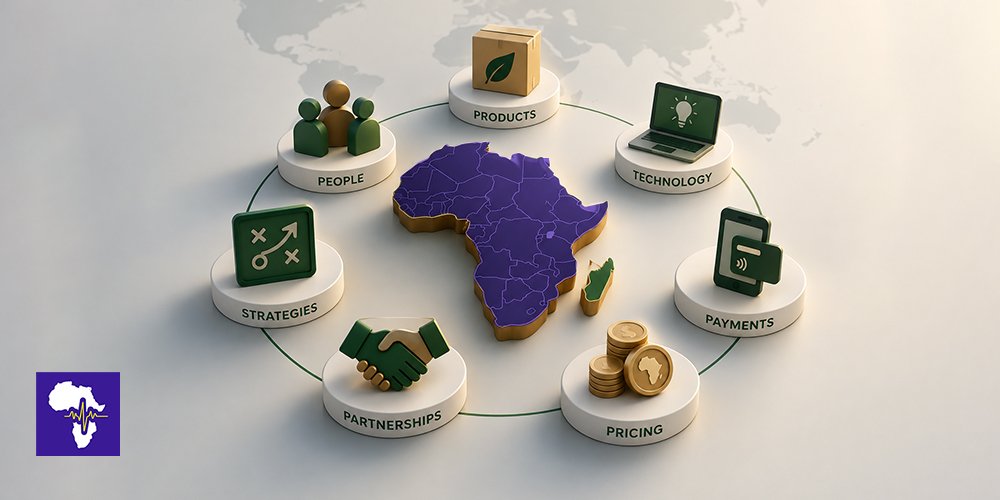
Africa does not need foreign companies that merely operate in Africa. It needs companies whose products, people, technology, payments, pricing, partnerships and strategies are built around African realities. For too long, localization has become a corporate shorthand for changing the currency, adding mobile money, translating a website, hiring a country manager, obtaining a license and putting an African celebrity in an advertisement. However, is that localization or simply exporting a foreign business model into Africa.
For investors, this is not semantics. Poor localization destroys value.
The questions companies should be asking is no longer, ‘’Do we localize?’’ It is far more uncomfortable: ‘’How much of our businesses model is actually localized?’’ There are three levels.
- Level One is Export: Here is our global product. Let us sell it in Africa.
- Level Two is Adaptation: Let us change the currency, payment methods, language and marketing.
- Level Three is Local Thinking: Let us redesign parts of our business around how African consumers, regulators, businesses and financial systems actually operate.
This distinction matters because Africa is becoming too economically important to be treated as a collection of distribution markets. Gaming is no exception. Sportbooks, casinos, fintechs, B2B platforms, payment providers, affiliates, technology companies and service providers are competing for an increasingly digital consumer. However, many still arrive with assumptions developed elsewhere and attempt to retrofit them to Africa.
That is expensive.
Take payments, if a gaming company’s payment begins and ends with Visa and Mastercard, it has not understood Africa. Mobile money, bank transfers, wallets, USSD and local payment rails are not peripheral conveniences.
They are central to how money moves across many African markets. GSMA reported that mobile money transactions reached $2 trillion globally in 2025, with Sub-Saharan Africa remaining the center of the ecosystem. For gaming companies, payments are not a back-office function. They are part of the product. A deposit that fails is a product problem.
A withdrawal that takes too long is a customer experience problem. A payment method that consumers do not trust is a conversion problem. Every unnecessary friction point can ultimately become a revenue problem.
Then comes perhaps the biggest strategic mistake: the ‘’One Africa’’ strategy.
A company announces Its “Africa Strategy”. The immediate question should be: Which Africa?
Nigeria is not Kenya. Kenya is not Ghana. Ghana is not South Africa. South Africa is not Tanzania. Tanzania is not Uganda. Even within a single country, consumers do not necessarily behave as one homogenous market. Localization therefore has to operate at multiple levels: continental, regional, country and consumer segment.
A sportbook that genuinely thinks local should not merely translate its interface. It should localize the betting proposition. Which sport matter? Which leagues attract attention? What betting markets resonate? What are the preferred stake levels? How important are accumulators, live netting, cash-out and local football content? What does the customer actually value. A product is not local because it is available locally. It is local when local behavior has influenced how it was designed.
The same principle applies to technology.
A European gaming platform may be technically sophisticated but can it handle intermittent connectivity, lower spec smartphones, expensive mobile data, local payments APIs, fragmented identity systems, local fraud patterns, multiple currencies, different regulatory regimes and country specific data requirements?
Africa digital infrastructure makes this question impossible to ignore. GSMA says 416 million people were using mobile internet in Africa in2024, yet almost 75% of the population remained unconnected at that time. Its latest 2026 report says approximately 63% of Africans still live within mobile broadband coverage without using mobile internet. That is not a technology footnote. It is a business design issue.
A platform designed on the assumption of permanent high-speed connectivity may perform beautifully in London or Amsterdam and poorly in parts of Africa. A customer service model built entirely around apps may fail where USSD, WhatsApp, agents or human support are more practical. A KYC system designed around one identity architecture may struggle in fragmented markets. This is why true localization must extend beyond marketing.
And people matter enormously.
Hiring one African country manager does not automatically make a multinational local. The more important question is whether local executives have genuine authority over product, commercial strategy, compliance, payments and customer experience. There is a difference between having Africans in the organization and allowing African intelligence to influence the organization. Investors should care about that distinction because localization is ultimately about economics.
Can the company acquire customers efficiently? Can it convert them? Can it retain them? Can it comply without excessive friction? Can it build trust? Can it design technology around actual usage condition? If the answer is yes, localization becomes a competitive decoration. If the answer is no, ‘’localization’’ becomes corporate decoration. Africa does not need companies that simply learn how to sell into Africa. It needs companies prepared to think in Africa, build for Africa and make decisions with Africa.
It is a market in which the business model itself may need to change and that is where the real localization battle begins.
Part Two of this series will examine what true localization looks like across people, payments, product, technology, regulation, pricing, data, partnerships and responsible gaming and how investors can measure whether a company is genuinely localized or simply pretending to be.