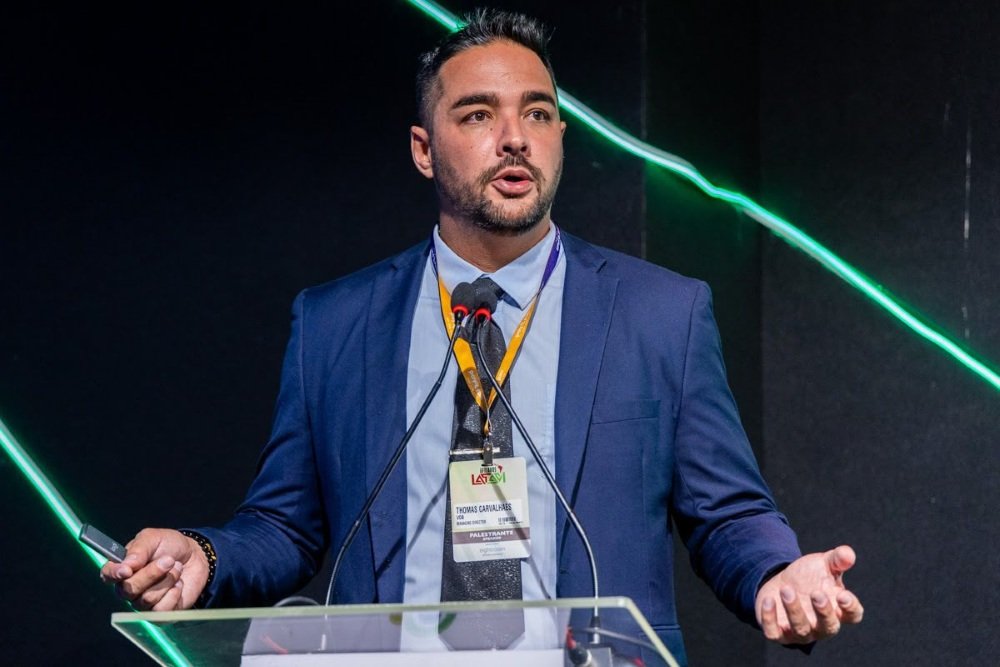
As Brazil’s betting industry navigates regulatory uncertainty and the consequences of aggressive policy making, the debate over sustainability, market stability and responsible regulation has never been more critical.
In this exclusive interview, Thomas Carvalhaes with John Bamidele, Editor- In- Chief of FindMore Africa brings a practitioner’s perspective to the future of iGaming in Brazil and Latin America.
He is CEO and Founder of TC Assessoria e Consultoria, a São Paulo-based iGaming advisory firm, a founding member and Council Member of ABRAJOGO, Founder and Advisory Board Member of Next.io LATAM Retreat, and Country Manager at Stake. He discusses why lasting regulatory frameworks require balance, industry collaboration and sustainable partnerships—not heavy-handed intervention.
You have been involved with government, operators and industry stakeholders in Brazil. What, in your view, fundamentally went wrong between the industry and policymakers that brought Brazil to the current betting restrictions?
The core issue was a widening gap in expectations and communication between policymakers and the private sector, rather than malicious intent on either side.
From the regulatory standpoint, the primary anxieties centered on consumer protection, social impact, and advertising visibility, which expanded rapidly as the market scaled.
On the industry side, many international operators brought established global compliance frameworks but underestimated how acutely sensitive Brazilian political stakeholders are to public perception and social narratives.
When aggressive marketing saturation and concerns over problem gambling collided with political cycles, the dialogue broke down. Instead of a collaborative framework built on data-sharing and gradual compliance maturation, the relationship deteriorated into reactive policy making, leaving both sides misaligned.
Brazil spent years developing a regulated betting framework and attracting international operators. Has the current ban fundamentally changed the investment case for Brazil, or is this a temporary disruption within a much larger market opportunity?
It represents a severe and painful disruption, but the underlying macroeconomic and demographic fundamentals of Brazil have not vanished. Brazil remains one of the most passionate sports and gaming markets globally.
However, the investment case has fundamentally evolved: investors can no longer treat Brazil as a standard, straightforward regulated market where regulatory stability can be taken for granted.
Future capital allocation will demand a higher risk premium, more robust legal safeguards, and localized operational strategies that insulate businesses against sudden political volatility. It is a temporary structural setback for institutional capital, but the underlying consumer demand ensures the market remains too large to ignore once a viable path forward re-emerges.
From your conversations with government and industry stakeholders, what are the real policy objectives behind the ban—and how closely do those objectives align with the reasons originally given for legalising and regulating betting?
Our dialogue with the government has always been through the Brazilian regulator, which was a sub secretary of the ministry of finance. The stated objectives of legalization were always clear: revenue generation, consumer safety, channeling grey-market volume into a transparent environment, and economic development. However, the real catalysts behind the current restrictions are political survival and public optics.
Lawmakers faced intense pressure from societal backlash regarding problem gambling, aggressive media campaigns, and perceived negative social externalities. The policy pivot is less about a fundamental rejection of a legal market and more about an urgent political reaction to regain control of the public narrative. The objectives shifted overnight from economic integration and taxation to political damage control.
One of the biggest concerns for investors is regulatory predictability. Has Brazil demonstrated that investors can comply with the rules and still face significant policy reversal? What does that mean for the country’s regulatory credibility?
Unfortunately, yes. Operators invested heavily in legal fees, local talent, compliance infrastructure, sponsorships, and licensing processes in good faith, only to face abrupt restrictions. This severe policy reversal inflicts deep damage on Brazil’s regulatory credibility.
When rules can change fundamentally after companies have already met every statutory requirement, it signals to international capital markets that regulatory frameworks lack institutional permanence. Restoring that credibility will take years of consistent, transparent policymaking and a deliberate effort to rebuild trust between government institutions and serious industry stakeholders.
What happens to the billions of dollars of capital, technology, employment, sponsorships and infrastructure that have been built around Brazil’s regulated betting ecosystem if the restrictions remain in place?
The collateral damage is immense. If these restrictions harden, we risk seeing a massive destruction of formal value: thousands of high-paying jobs in technology, compliance, and marketing will be lost or forced offshore; major sports club sponsorships and media partnerships will collapse, starving Brazilian sports of critical revenue; and millions of reais in sunk technological infrastructure will go underutilized.
Capital will inevitably retreat, and rather than eliminating gambling, the ecosystem will simply experience a forced regression back into informality, depriving the state of tax revenue while leaving consumers entirely unprotected.
Could the ban unintentionally strengthen Brazil’s illegal and offshore betting market? From an operator and consumer perspective, what would make the regulated market more attractive than simply pushing players toward alternatives outside government oversight?
It will almost certainly supercharge the unregulated offshore market. Prohibition does not stop consumer demand; it merely drives it underground where consumer protection, data privacy, and integrity safeguards do not exist.
To make a regulated market more attractive than unlicensed alternatives, policymakers and regulators must ensure that the official framework offers a superior user experience combined with competitive commercial conditions—such as reasonable taxation, frictionless payment rails via trusted infrastructure like Pix, and sensible product offerings.
If compliance hurdles and tax burdens make the legal product uncompetitive, consumers and operators alike will naturally gravitate toward offshore alternatives that operate outside government oversight.
Brazil’s betting market involves operators, banks, payment providers, technology suppliers, affiliates, sports clubs and media companies. Which parts of this ecosystem are most exposed to the current regulatory shock, and which could potentially adapt?
The entities most directly exposed are licensed operators with heavy local overhead, sports clubs reliant on shirt sponsorships, and media groups counting on betting ad revenue. Their business models depend entirely on volume and public visibility within a sanctioned market.
Conversely, technology suppliers, global software providers, and affiliate networks possess much higher agility; many of these B2B players can pivot their infrastructure or reallocate resources to other expanding Latin American jurisdictions.
Meanwhile, payment providers and financial institutions face a delicate balancing act, they risk losing regulated transaction volume, though they retain core utility across the broader digital economy.
You participated in establishing ABRAJOGO to create dialogue between government, industry and the public. What have you learned from that dialogue about the biggest disconnect between what policymakers believe the betting industry is doing and what the industry believes it is actually doing?
The single biggest disconnect is the profound gap between the industry’s technical reality and the political perception of its intent. Policymakers often view operators through a lens of suspicion, assuming every commercial strategy is designed to maximize extraction at the expense of social welfare.
Conversely, operators view themselves as regulated entertainment providers utilizing sophisticated data analytics and global compliance tools to foster a safe environment.
The dialogue taught us that the industry failed to effectively translate its complex technical mechanisms, such as algorithmic player protection and anti-money laundering protocols into a language that resonates with lawmakers and the general public. Bridging that communication gap is essential for any future regulatory stability.
Looking beyond Brazil, what should regulators and investors in other emerging markets learn from this episode about designing a gambling framework that protects consumers without destroying investor confidence?
The primary lesson is that sustainability relies on balance and partnership, not heavy-handed paternalism or rushed rulemaking. Regulators in emerging markets must co-design frameworks in open consultation with industry operators from day one, ensuring that tax rates, advertising guidelines, and compliance burdens are realistic enough to starve the black market rather than feeding it.
For investors, the takeaway is absolute diversification of regulatory risk, and never assume that passing legislation marks the end of regulatory uncertainty. Long-term success requires continuous stakeholder engagement and active participation in local industry associations to protect the integrity of the market.
If you were advising an international investor today with substantial capital available for emerging-market gambling opportunities, what questions would you tell them to ask before putting money into a newly regulated market?
I would advise them to look past the market size headline and grill local stakeholders on four critical questions:
- What is the true political consensus behind this regulation, and how vulnerable is the framework to sudden populist or political shifts?
- Are the tax structures and compliance costs commercially viable, or do they inadvertently incentivize operators and consumers to remain in the grey market?
- What level of institutional independence do the regulatory bodies possess, and can they withstand short-term political pressures?
- What localized partnerships and compliance infrastructure are in place to navigate unexpected regulatory friction without threatening core capital?