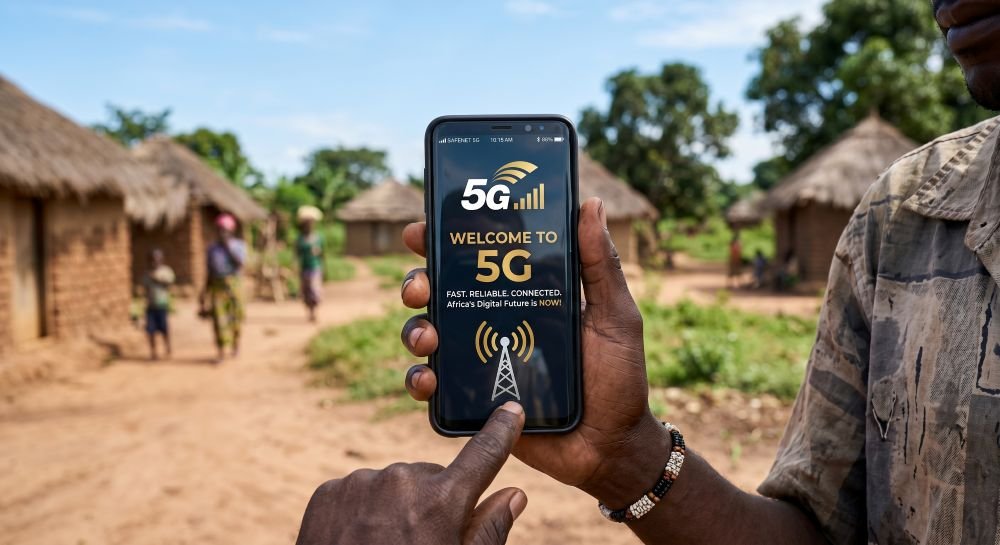
Africa’s digital economy is entering a new phase and the numbers are becoming too significant to ignore. While much of the global conversation around 5G has centered on North America, Europe and Asia, the next major growth story may well be unfolding in Sub-Saharan Africa.
According to the latest Ericson Mobility Report, Sub-Saharan Africa is projected to record the fastest 5G subscription growth in the world over the next five years, rising from just 30 million subscriptions in 2025 to 370 million by 2031. That represents more than a twelve-fold increase in one of the world’s youngest and fastest-growing consumer markets.
The report also notes that global 5G subscriptions surpassed three billion in first quarter of 2026 with half of all mobile data traffic running on 5G networks. Africa is preparing to join that transformation at an accelerated pace. The region’s mobile ecosystem is evolving rapidly. Total mobile subscriptions are forecast to increase from 1.05 billion in 2025 to 1.31 billion by 2031, supported by continued 4G expansion and the early rollout of 5G infrastructure. Legacy 2G and 3G networks are expected to decline as consumers migrate to faster, more capable networks.
Perhaps even more significant is the smartphone opportunity. Smartphone subscriptions are projected to reach 960 million by 2031, increasing their share of all mobile subscriptions from 57 percent to 73 percent. Behind those figures are three powerful structural drivers: Africa’s youthful population, greater access to affordable smartphones and instable appetite for digital services. Data consumption tells an equally compelling story.
Monthly mobile data usage per smartphone is expected to more than double from 5.3GB in 2025 to 12GB by 2031 while total mobile data traffic across Sub-saharan Africa is forecast to surge from 2.8 exabytes per month to 9.7 exabytes per month over the same period.
For investors, these are not merely telecommunications statistics. They are leading indicators of broader digital economic expansion. Higher-quality connectivity creates the infrastructure upon which digital businesses scale. Every additional smartphone user represents a potential customer for digital payments, e-commerce, entertainment, online education, healthcare platforms and financial services.
For Africa’s gaming industry, the implications are profound. Faster networks and lower latency improve user experience for mobile sportsbooks, online casinos, live dealer products, esports and skill-based gaming. Operators will be able to deliver richer content, faster transactions and more engaging in-play betting experiences to a much larger addressable market.
Fintech stands to benefit just as significantly. As smartphone penetration rises, digital wallets, mobile banking, cross-border payments, embedded finance and Buy, pay Later Solutions become more accessible to millions of previously underserved consumers. Better connectivity also strengthens digital identity verification, fraud detection and real-time payment infrastructure.
Technology providers should also take notice. Demand for cloud services, cybersecurity, artificial intelligence, data analytics, payment infrastructure, customer engagement platforms and digital identity solutions is likely to accelerate alongside network expansion.
The broader investment thesis is clear. Africa is no longer simply adding mobile subscribers; it is building the digital infrastructure required for a modern internet connectivity. Connectivity is becoming the foundation for new business models, stronger consumer spending and high-value digital services. Markets that experience rapid increases in smartphone adoption and mobile data consumption rarely transform just one sector. They create ripple effects across payments, gaming, commerce, media, logistics and financial inclusion.
For investors seeking long-term structural growth rather than short-term market cycles, Sub-saharan Africa’s mobile revolution deserves close attention. As 5G deployment accelerates and nearly one billion smartphone users come online, the region is positioning itself as one of the world’s most compelling frontiers for digital investment.
The infrastructure is expanding. Consumers are connecting. Data usage is soaring. For investors, the next decade may not simply be about Africa’s digital growth- it may be about participating in one of the latest-growing connected economies in the world.