Esports South Africa scene is evolving from a casual hobby into a serious business, with prize pools, sponsorships, and professional contracts turning gamers into earners. This transformation is opening new career pathways and reshaping how young people engage with digital innovation and competitive play.
Esports represent the structured, competitive side of video gaming, where individual players or teams compete in professional tournaments and leagues for prizes and recognition.
Fans watch and cheer, either online or at live events, similar to traditional sports. Structured leagues, tournaments, and ranking systems organize esports players, and professional gamers often have coaches, analysts, and dedicated training schedules, much like conventional athletes.
“Today, esports are not only about playing games,” said Jaco Sauer, co-founder and general manager at RGB Gaming, an esports management and development company. “It is an all-encompassing program that exposes players to everything from tournaments and hackathons to game design and business development.”
As South Africa positions itself within the global digital economy, esports is becoming a gateway for youth participation in technology-driven industries. Beyond prize money and tournaments, it nurtures a new generation fluent in coding, data analytics, content creation, and entrepreneurship.
The country’s expanding esports ecosystem is also catalyzing innovation in streaming and marketing, showing that gaming can be both an economic accelerator and a tool for digital inclusion. In 2020, South Africa’s esports market was valued at about $14.3 million.
Since then, it has surged and is expected to reach approximately $29 million in revenue by 2025, with projections as high as $44.1 million by 2030.
This revenue comes from various sources, including sponsorships, prize pools, advertising, media rights, and merchandise. The market has experienced annual growth rates of 18.7% to 24%, driven by increased sponsorships, digital engagement, and mobile access.
Sauer noted that esports betting has become a significant driver of revenue in South Africa and globally. With the rise of professional gaming tournaments and increased viewer engagement, fans are now placing real-money wagers on match outcomes, player performances, and in-game events.
According to PwC’s Africa Entertainment and Media Outlook 2025–2029 report, South Africa is Africa’s largest esports market, supported by local tournaments, campus leagues, and community-led gaming hubs.
Organizations like Mind Sports South Africa (MSSA) and the Confederation of African Esports (CAES) are helping local gamers rise through global ranks across mobile, desktop, and console platforms.
Private tertiary institutions like Eduvos are investing heavily in esports, viewing it not only as a sport but also as a learning platform that blends teamwork, digital literacy, and critical thinking. Eduvos launched its campus-wide esports program in 2023, believing that gaming builds transferable skills that are valuable in the workplace. The university has rolled out esports across all 12 campuses, engaging over 300 gamers and forming partnerships with eight high schools.
Tony Matchaba-Hove, Eduvos’ Bedfordview Campus general manager, remarked, “Esports has been a big push for us since last year. The link between education and gaming is what drives us to create future-ready graduates. Too often, students leave university with knowledge that is not easily transferable to the working world. Gaming helps us close that gap.”
Ruben dos Santos Pires, a third-year software engineering student, has been part of Eduvos esports community for two years. Competing in games like Overwatch and Apex Legends, he has won several tournaments.
He cites gaming as a way to manage stress and stay focused. “The competitiveness of esports keeps me going,” he says. “It’s friendly, but I also get creative ideas from the games, along with prizes, tournaments, and a sense of achievement.”
“Students are not just gaming for entertainment; they are integrating competitive play, digital learning, and tech-focused extracurriculars into their academic growth,” says Tian van der Merwe, an information technology lecturer at Eduvos.
“It’s a tool for wellness, teamwork, and even career preparation.” South Africa is home to some of Africa’s largest esports teams, including ATK, Bravado Gaming, and Goliath Gaming. In 2020, Clo ud9 signed a South African duo to play Counterstrike: Global Offensive (CS:GO), showcasing local talent on the global stage.
Globally, esports is now a multi-billion-dollar industry, with top players like Denmark’s Johan “N0tail” Sundstein earning over $7 million from tournaments, rivaling traditional athletes. While South Africa’s figures are smaller, they are on the rise.
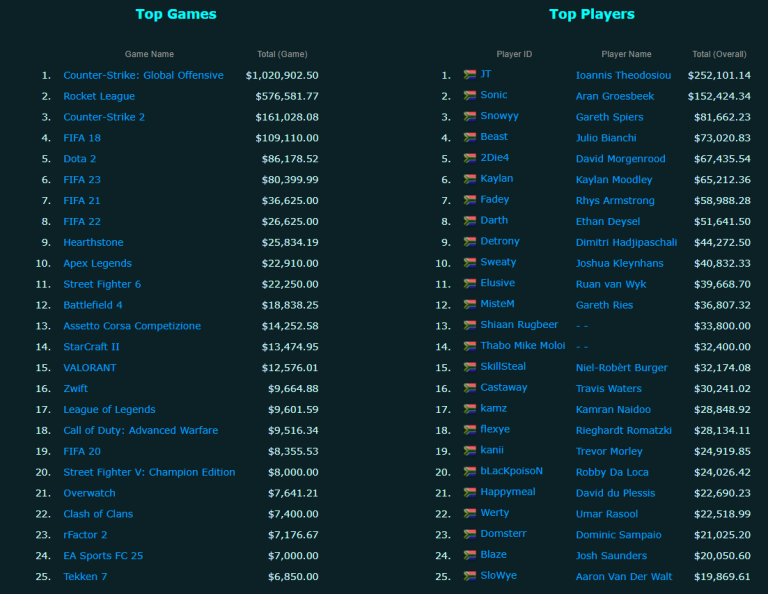
According to Esports Earnings, 846 South African esports players have collectively earned over $2 million in prize money across 648 tournaments. The most lucrative title is CS:GO, accounting for over $1 million in winnings, representing 43% of all earnings by South African competitors. Ioannis “JT” Theodosiou is the country’s top-earning player, with total winnings exceeding $250,000, of which nearly $170,000 (67%) comes from CS:GO.
Big corporations in South Africa are increasingly investing in esports. Nedbank, through its YouthX initiative, has partnered with Goliath Gaming to create opportunities for aspiring esports players.
Telecom companies like MTN, Vodacom, and Telkom are backing tournaments, building digital arenas, and sponsoring leagues. During these esports events, young gamers often receive professional training while competing for cash prizes.
In 2025, Comic Con Africa featured a total prize pool of more than R600,000 ($34,722) for its major esports tournaments, including Telkom VS Gaming’s High School Esports League and CS2 Masters.
The gender balance in South African esports is gradually improving, with notable efforts aimed at increasing female participation and visibility in the industry. Major events like the 2024 Mzansi Esports Champions, held at Johannesburg’s rAge Expo, have spotlighted female players, such as Zahraa Khan (“Iron-Fist”), who won the championship against competitors from eight Southern African countries.
The MSSA federation has implemented policies to strive for gender equality in national squads, aiming for about 50% female representation in team selections.
“We are seeing a massive increase in female gamers,” Sauer said. “Traditionally, esports were very male dominated, but over the last two years, we’ve seen more women entering the space. Esports is one of the few sports that allows inclusivity across all levels, regardless of gender, age, or background.”
First-person and third-person shooters (FPS/TPS), particularly CS:GO and PUBG MOBILE, remain the most popular genres in terms of participation and revenue. At Eduvos, students can participate in free inter-campus leagues that they organize themselves.
Through a partnership with RGB, they can access a full catalog of competitive games for a minimal subscription fee, unlocking entry into Africa’s largest inter-campus esports league and pathways to national competitions like Comic Con Africa and rage.
As esports cements its place in South Africa’s digital economy, the next phase of growth will depend on investment in infrastructure, local content creation, and policy frameworks that nurture talent from the grassroots.
The country stands at a tipping point, with universities, corporations, and tech innovators now viewing gaming as more than just recreation, it is emerging as a viable industry and a skills engine. With falling data costs and expanding access to high-speed internet, esports could evolve into one of South Africa’s most dynamic youth-driven sectors.