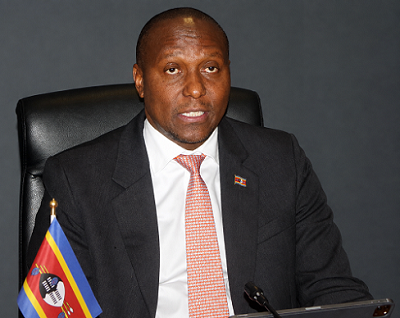
Prime Minister Mmiso Russell Dlamini has said police should be allowed to perform their duties without interference from politicians or other individuals. Dlamini made the remarks in response to journalists who asked about reports alleging that some politicians had interfered with police investigations and arrests involving people accused of operating illegal gambling businesses in Eswatini.
The journalists asked whether any reports concerning the alleged interference had been brought to the Prime Minister’s Office and what action would be taken if such reports were confirmed. In response, Dlamini said it would be helpful if the politicians allegedly involved were identified.
He said no reports had so far been brought to his office concerning claims that certain Cabinet ministers had interfered with the police. The Prime Minister stressed that police must carry out their duties in accordance with the law and without interference. He added that anyone involved in criminal activities should be arrested and brought before the courts so that the law can take its course.
The allegations emerged following the arrest of more than 150 foreign nationals from several countries, mostly Asian, for allegedly operating illegal gambling businesses in Eswatini. Those arrested reportedly came from countries including Mainland China, Taiwan, Indonesia, Thailand, the Philippines, Brazil, Cambodia and India.
Some of the suspects have reportedly been deported following conviction, while others remain in custody pending repatriation. The alleged kingpin is currently in custody alongside two other suspects, pending trial. They are expected to stand trial together with three emaSwati accused of hiring the foreign nationals and operating the illegal gambling businesses.
Eswatini will not overcome its health challenges without employing sufficient staff, according to the World Health Organisation (WHO). The advice was given to the Prime Minister’s Office during the WHO’s recent visit to the country.
Prime Minister Dlamini disclosed this during a press conference with journalists at the Cabinet Office conference room. He said government was prioritizing the health sector by ensuring that it receives adequate funding as preparations begin for the next financial year’s budget.
“Government has heard that it should prioritise health,” he said.
Many countries, including Eswatini, continue to face challenges in meeting the international health spending benchmark established under the Abuja Declaration, which calls for at least 15 per cent of annual government budgets to be allocated to health.
Meanwhile, Minister for Public Service Mabulala Maseko said government had made efforts to fill vacancies within the Ministry of Health. Maseko said 127 health workers had been hired, according to the ministry’s report.
However, he highlighted several challenges affecting the recruitment of health professionals, including Circular No. 3 of 2018, which introduced a hiring freeze and limited the number of employees government could recruit.
He said the Ministry of Public Service and the Ministry of Health were continuing discussions aimed at ensuring the recruitment of health personnel. Maseko acknowledged that the health ministry continues to face a shortage of staff.
After three years in office, government says it has made tangible progress in addressing issues raised during the Sibaya national consultations. Prime Minister Dlamini made the remarks during the press conference at the Cabinet Office conference room.
He said government had considered public submissions on issues including drug shortages in health facilities, scholarships and land grabbing when implementing measures under the ‘Nkwe’ approach. Dlamini highlighted improvements in the availability of medicines in health facilities.
According to the Prime Minister, drug availability stood at approximately 30 per cent when the current government assumed office. Through the efforts of various stakeholders, availability has since increased to about 90 per cent. Drug shortages in hospitals were among the major concerns raised during the Sibaya consultations.
The severity of the problem prompted calls for investigations to identify those responsible and ensure that they face legal action. Minister for Finance Neal Rijkenberg, who was among the panelists addressing the issue, also called for thorough investigations into the drug shortages.
Dlamini further said government had fulfilled its commitment to pay civil servants following a salary review conducted by an external consultant. He said the number of scholarship beneficiaries had also increased, while monthly allowances for sponsored students had been raised.
For the 2026/2027 financial year, government increased tertiary scholarship slots to 4,500, representing an increase of approximately 1,000 beneficiaries from the previous year. Monthly allowances were also increased from E1,690 to E2,000.
Dlamini said government had also started constructing a cold storage facility near the airport to support large-scale agricultural projects targeting overseas markets.
He added that government had made progress in constructing decent houses for elderly people and vulnerable children through the Deputy Prime Minister’s Office.
Minister for Public Service Mabulala Maseko has clarified concerns surrounding the back-pay formula used following the government’s salary adjustments. Maseko said some civil servants had incorrectly calculated their expected payments, leading them to believe they had been underpaid.
He explained that the correct formula was based on the difference between employees’ old and new salary scales. According to Maseko, some employees mistakenly treated the remaining 85 per cent of their back pay as part of their annual basic salary.
He gave an example of an employee entitled to E5,000 in back pay, explaining that the amount was multiplied by six to cover the six months of back pay. The payments were then taxed accordingly.
Maseko also used politicians as an example, explaining that deductions including tax and contributions to MOPADO meant the amount received could be lower than some had anticipated.
“I was referring to back pay for the salary review, not the annual basic salary as some perceived,” Maseko clarified.
He said government had played a significant role in ensuring that the promised back pay was paid to civil servants. Prime Minister Dlamini added that government had established a committee to handle appeals from civil servants with concerns about their back-pay calculations. He said the initiative was intended to promote transparency and ensure that employees’ concerns were properly addressed.