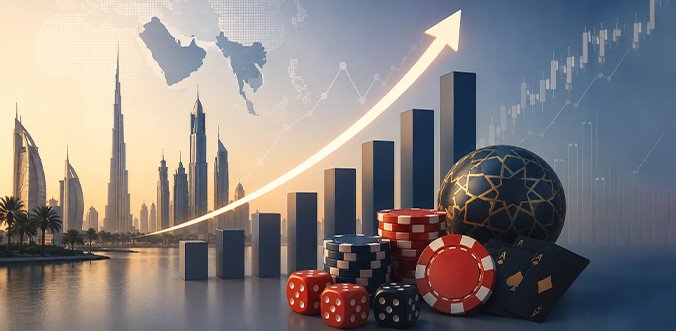
The Middle East is no longer a speculative conversation in global gambling; it is a capital-backed reality in motion. The region is rapidly shifting from an emerging gaming conversation into a capital-backed digital entertainment ecosystem driven by sovereign investment, policy reform and explosive gaming consumption growth. At the core of the opportunity is market expansion. The broader Middle East Gambling market was valued at approximately USD 18.8 billion in 2025, with projections showing it could reach USD 45.3 billion by 2034 growing nearly 10% CAGR according to IMARC Group.
Precedence Research conservative estimates place the region at around USD 8-9 billion in near-term gaming revenue, with steady double-digit expected through the next decade. Within this, esports and gaming are accelerating even faster. The regional esports market alone is forecast to grow from USD 8.1billion in 2025 to cover USD 55 billion by 2035 says Yahoo finance. The positions the region as one of the fastest-growing competitive gaming ecosystem globally.
Unlike mature gambling markets driven by saturation and competition, the Middle East is evolving through intentional economic design. Governments across the region, most notably the United Arab Emirate (UAE) and Saudi Arabia, are actively diversifying away from hydrocarbon dependency, prioritizing tourism, digital infrastructure, esports and entertainment ecosystems.
Within this transformation, gaming is emerging as a controlled but high-valued growth sector. At the center of this shift is structured regulation rather than unrestricted liberalization. The region is not opening its markets indiscriminately; instead, it is building framework-driven ecosystems that allow specific forms of gaming-related activity under tightly governed conditions. This includes regulated lottery systems, skilled-based gaming, esports and digital entertainment platforms that aligned with cultural and legal frameworks.
A key example is the UAE, which has positioned itself as a regional innovation hub. With advanced infrastructure, global connectivity and free zones designed for technology and media companies, UAE has become a gateway for gaming publishers, esports operators and digital entertainment firms. The establishment of formal regulatory bodies for gaming -related activities signals a clear intent: controlled expansion with institutional oversight.
Saudi Arabia meanwhile, is executing one of the most ambitious economic transformation programs globally under its vision 2030 agenda. Large-scale investments in entertainment cities, sports infrastructure and esports tournaments reflect a deliberate strategy to position the kingdom as a global gaming and digital entertainment destination. The focus is not traditional betting but rather immersive entertainment ecosystems that align with regulatory and cultural boundaries.
For investors, one of the most attractive aspects of the middle East is capital alignment. Sovereign wealth funds and state-backed investment vehicles are actively deploying capital into technology, media and gaming adjacent sectors. This creates a unique environment where funding, infrastructure and policy direction are often aligned to the highest level, reducing friction for compliant operators. However, entry into the region demands precision.
Success depends on regulatory alignment, cultural sensitivity and partnership-driven expansion models. In the Middle East, operators cannot replicate Western iGaming frameworks: instead, they must build locally adapted propositions that comply with strict legal boundaries while still delivering engagement and value.
In conclusion, the Middle East is not yet a mass iGaming market but it is an investment-designed ecosystem in motion. Its combination of capital strength, regulatory evolution, digital readiness and strategic government backing makes it one of the most promising long-term gaming and esports investment destinations globally. Those who enter early and align with policy direction will not just participate in the market; they will help define it.