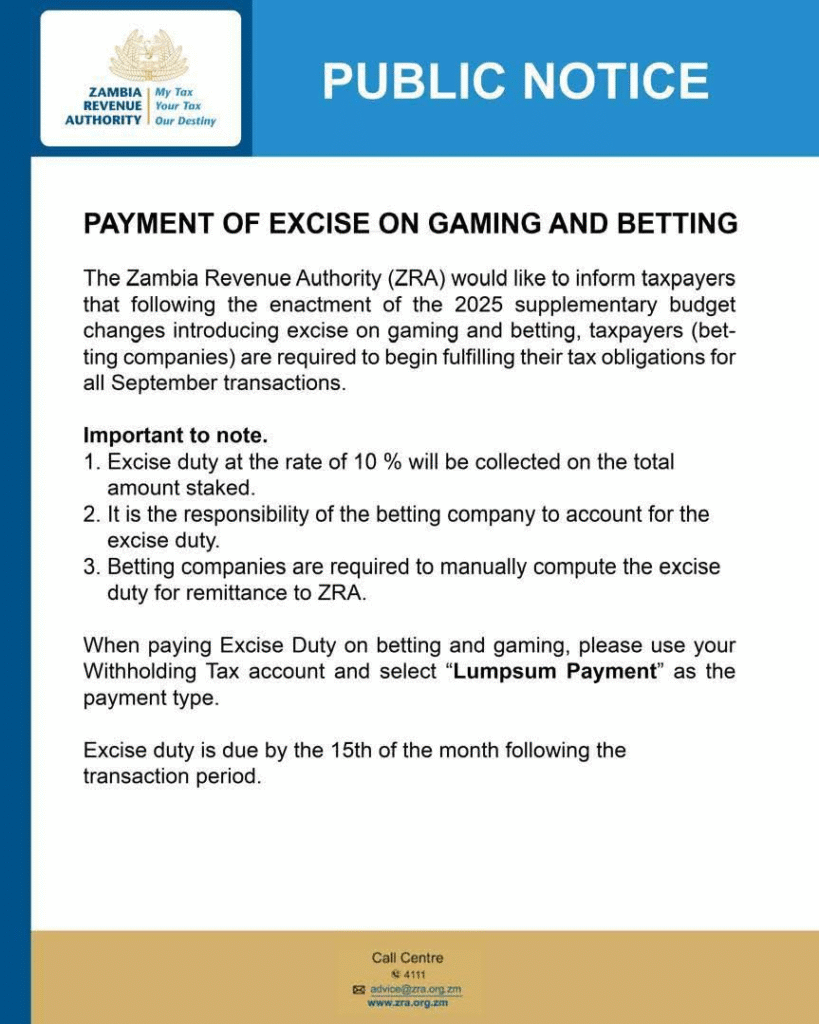
Betway and several other betting companies temporarily suspended their operations in Zambia due to a new 10% excise duty on betting stakes, arguing that this tax made the business environment “financially unsustainable” in October 2025.
BetPawa and Betway filed a constitutional petition to prevent the government from enforcing the new excise duty. They claimed the tax was “excessive, ambiguous, unimplementable, and financially unsustainable.” Additionally, they criticized the lack of transparency and consultation with the industry during the legislative process, warning that the tax could lead to business closures and job losses
Oliver Nzala, ZRA’s Corporate Communications Manager, confirmed this decision in a statement to ZNBC News. The companies argued that Section 7 of the Customs and Excise Act of 2025, which introduced the excise duty, was unconstitutional. They cited alleged violations of various constitutional articles, claiming the law lacked transparency and adequate public consultation, which would result in severe economic consequences. Nzala noted that the petitioners described the tax as excessive and financially unsustainable, warning it could lead to business closures and job losses.
The Constitutional Court has dismissed the application from BetPawa and Betway, which aimed to stop the Zambia Revenue Authority (ZRA) and the Attorney General from imposing the new excise duty on betting stakes. In response, the ZRA maintained that the excise duty is a consumption tax paid by betting players—not operators—and that the law was enacted after stakeholder engagement. They argued that the financial projections provided by the companies were speculative and not backed by audited data.
The petitioners also sought an interim injunction to halt the enforcement of the excise duty until a full hearing could occur, asserting that the tax burden exceeded their gross gaming revenue and was introduced mid-financial year, making compliance impractical. They argued that potential damages would not adequately remedy the harm caused.
The ZRA countered that the tax was lawful, implementable, and aligned with its constitutional mandate. They emphasized that suspending tax collection would undermine the widely accepted principle of “pay now, argue later,” which is foundational to tax administration worldwide. Ultimately, the Court ruled that the petitioners failed to present a sufficiently serious constitutional issue to justify suspending the law at this stage.