Betway, owned by NYSE-listed Super Group, has established a “market leader position” in the South African market in just eight years, outpacing competitors that have been active for two decades. This was highlighted at a recent investor day in London.
According to a source in the gaming sector, Betway and Hollywoodbets currently hold the top two positions in the market, commanding a significant share together. Betway claims “podium positions” (top three) in seven of its eight African markets, with Nigeria being the exception. However, its operations in Nigeria are profitable, and with clarified regulations, the company is poised to “super invest” in that market.
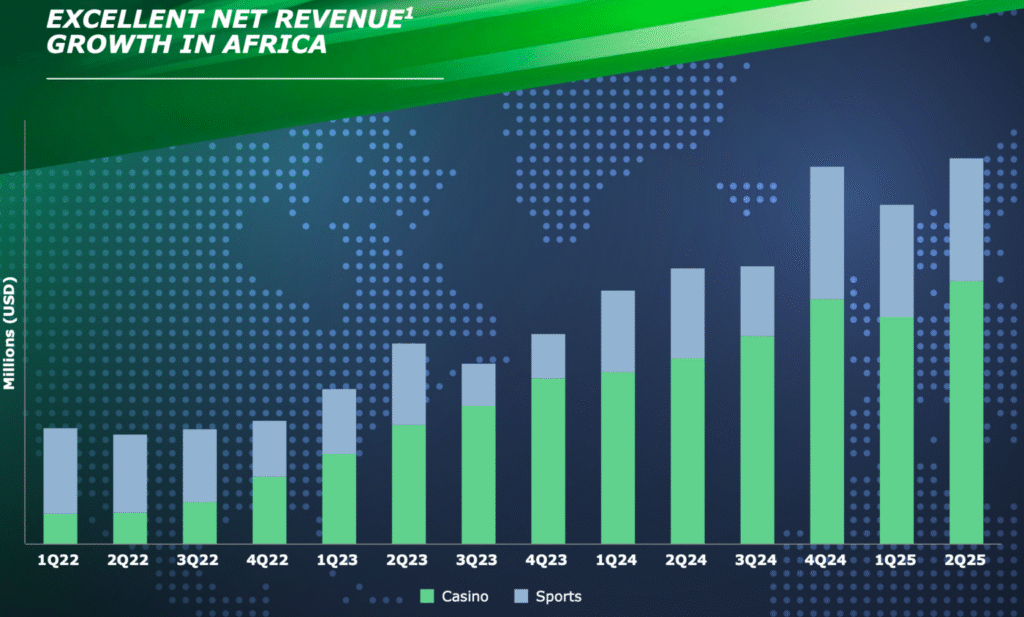
Africa is a crucial market for Super Group, which acquired Betway in 2010. In the first half of 2025, the company generated $420 million in net revenue (approximately R7 billion) from these eight markets. Betway has been active on the continent for ten years, launching in Kenya and Uganda in 2015, Ghana a year later, and entering Nigeria and South Africa in 2017.
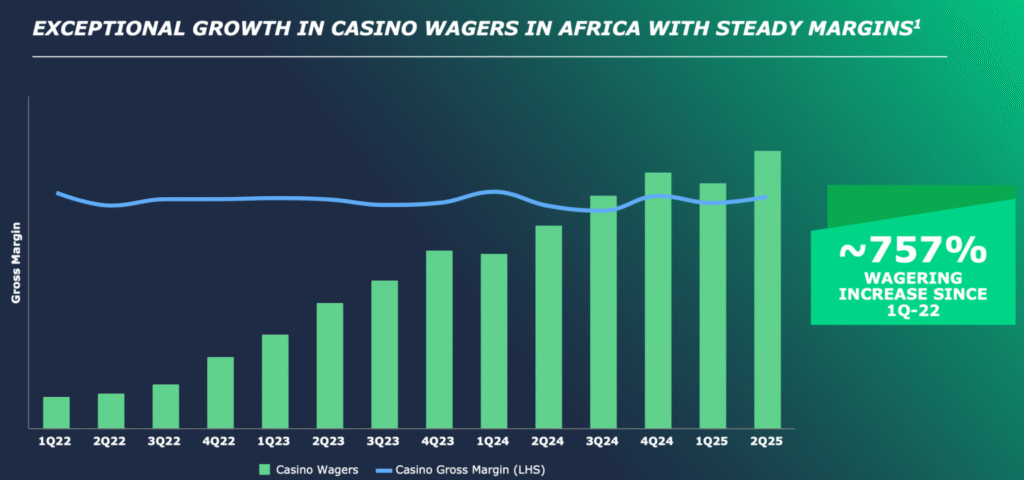
The company has around 1,000 employees dedicated to Africa out of a total of 3,000 globally. Casino wagers on Betway’s African operations have surged 750% since the first quarter of 2022, while sports wagers have increased by 52% during the same period. By Q2 2025 (ending June 30), casino games contributed 68% of net revenue in Africa, with sports making up the remaining 32%.
The casino vertical in non-African operations (UK, Canada, Mexico, Spain, and Germany) accounted for 65% of net revenue, with Jackpot City being the leading casino brand. In this sector, slots and similar games make up 89% of offerings. Sports betting, represented by the Betway brand, serves primarily as a “customer acquisition engine,” facilitating cross-sales to the casino vertical.
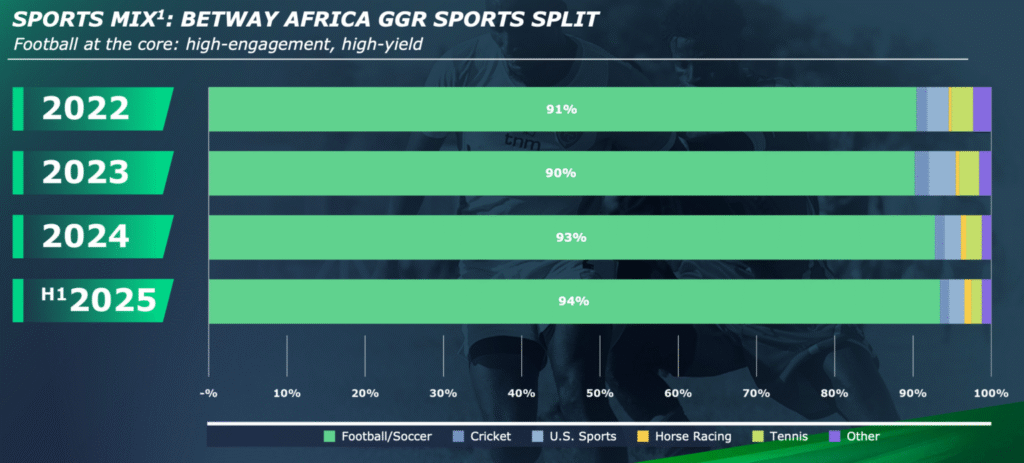
Football drives the sports betting business, accounting for about 75% of wagers, with cricket, US sports, horse racing, and tennis making up an additional 20%. In Africa, football’s share is even higher at an impressive 94%. Betway has partnerships with nine Premier League clubs, including Manchester City, Arsenal, and Chelsea, and is the title sponsor of the PSL (Betway Premiership). Additionally, it sponsors the SA20 tournament and is an official partner of the Springboks, enhancing its brand reach.
Betway has announced plans to allocate 22% of its annual revenue approximately R8.5 billion toward marketing initiatives this year. This investment reflects the company’s commitment to expanding brand visibility and enhancing customer engagement. The company serves an average of 5.5 million active users each month, reaching a record six million in September. By leveraging proprietary data models, Betway classifies players as “optimal,” “sub-optimal,” or regular.
This classification allows for highly personalized rewards based on gaming behavior and experience. Notably, revenues from “optimal” customers at its Jackpot City operation in the United States have grown over 2.5 times faster than those from other segments. Approximately 95% of its revenues come from ten countries, including South Africa, Canada, the UK, New Zealand, Ghana, the US (from which it is exiting), Spain, Botswana, Zambia, and Mozambique.
Notably, Betway holds a remarkable 95% market share in Botswana, its best launch ever, having entered the market in February 2025. Beyond its current eight markets, Betway is looking to expand into Namibia, Angola, Ivory Coast, and Ethiopia. A significant 67% of wager amounts in its African markets are for parlays, combined bets on multiple outcomes especially popular in football. Parlays account for 90% of gross wins in Africa, compared to 77% of gross wins globally.
Betway estimates a total addressable market in Africa of $11.9 billion by 2030, up from an estimated $6.4 billion this year. In South Africa alone, the projected market size by 2030 is $3.75 billion (R65 billion), assuming current regulations remain unchanged. Super Group reports that 56% of its global customers use at least one responsible gaming tool, such as deposit limits and session limits.
On its Q3 investor call, CEO Neal Menashe announced plans to launch the ZAR Super Coin in late November, in partnership with Luno, South Africa’s largest consumer crypto exchange. This rand-pegged stablecoin aims to enhance customer loyalty, reward engagement, and facilitate cross-platform benefits across Super Group’s ecosystem. The digital asset wallet is expected to launch in Q1 2026, starting in South Africa, where alternative payment methods are gaining traction. The group anticipates that this innovation will lead to cost efficiencies over time.