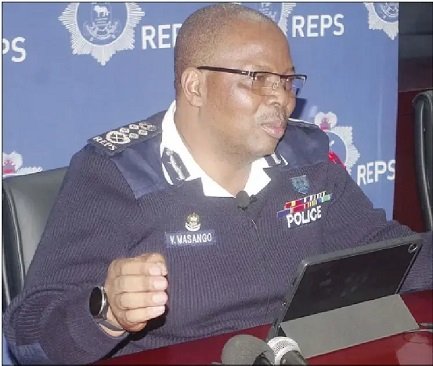
The Royal Eswatini Police Service (REPS) is set to meet Brazilian investigators over the ongoing probe into an alleged transnational illegal online gambling network. National Commissioner of Police Vusi Mamba Masango confirmed the development. He said local investigators would engage their Brazilian counterparts as part of efforts to dismantle what authorities believe is a sophisticated transnational criminal network operating across several countries.
The meeting follows discussions between Masango and a Brazilian police commissioner and comes as investigations continue into a sprawling illegal online gambling operation that police have described as one of the most complex criminal enterprises uncovered in the country in recent years. Masango said the investigations were aimed at determining the next course of action following the arrest of foreign nationals from Brazil, Mainland China, the Republic of China on Taiwan, Cambodia, Thailand, Indonesia, Malaysia, the Philippines, Myanmar, Vietnam and India, among other countries.
“We will be meeting our counterparts from Brazil in South Africa this week as part of ongoing investigations. Illegal gambling is a demon affecting many countries and we will not rest until we crush it,” said Masango. The national commissioner said the investigations could result in further arrests depending on evidence gathered through international cooperation. The latest development comes amid reports that international law enforcement agencies, including Interpol and the Federal Bureau of Investigation (FBI), have been roped into the investigations.
Earlier reports revealed that some of the accused persons arrested in Eswatini were already on Interpol’s red list and had allegedly been linked to similar criminal activities in other jurisdictions. Investigators have been trying to establish how some of the accused persons entered Eswatini and whether the country was deliberately selected as a base for international online criminal operations.
Police have previously indicated that the operation under investigation extends beyond illegal online gambling and includes allegations of money laundering, computer-related fraud, extortion and immigration violations. Evidence gathered so far suggests that the accused persons may have been involved in a criminal model commonly referred to internationally as “pig butchering”, where victims are allegedly lured into fraudulent online platforms and manipulated into parting with large sums of money.
The investigation first came to public attention in March when police launched intelligence-driven raids targeting suspected illegal gambling operations in Mbabane and surrounding areas. The first major breakthrough came after police swooped on Castle Hotel at Thembelihle, where 85 foreign nationals were arrested. Investigators alleged that the accused persons were operating an illegal online gambling enterprise using numerous electronic devices. Authorities also established that many of those arrested were in the country unlawfully.
As investigations intensified, police widened their operations and uncovered additional sites linked to the syndicate. Subsequent raids were carried out at Madlenya House, Hawane, Forbes Reef, Woodlands and other locations around Mbabane. The operations resulted in dozens more arrests, bringing the total number of accused persons arrested to approximately 150.
The accused persons included foreign nationals from Asia, South America and other regions, as well as company directors and a number of local individuals alleged to have assisted the operation. Police have maintained that the arrests were not random but followed extensive intelligence gathering and surveillance. Investigators believe the accused persons established a sophisticated network designed to evade detection.
Senior police officials previously disclosed that some of the foreign nationals conducted detailed research into Eswatini’s laws, economy and law enforcement systems before setting up operations in the country. According to police, investigators uncovered evidence suggesting that the accused persons studied local business regulations, immigration procedures and technological capabilities before establishing their bases. Authorities believe this planning enabled the syndicate to operate for some time before law enforcement agencies moved in.
The scale of the operation became clearer after investigators seized large quantities of electronic equipment during coordinated raids. Court documents reveal that police confiscated 313 electronic gadgets, including laptops, desktop computers, computer monitors, cellular phones, central processing units and Wi-Fi routers. Investigators alleged that the equipment was used to facilitate illegal online gambling, computer-related fraud, extortion and money laundering activities.
The accused remain in custody as proceedings continue after the June 12 court appearance. Among those facing charges are foreign nationals and company directors linked to the alleged operation. One of the individuals identified by prosecutors as a key figure in the case is Chinese national Lyu Tao, who is facing charges under money laundering legislation, illegal gambling laws and immigration-related offences. Tao recently withdrew a High Court bail application as preparations for trial continue.
The case has attracted considerable public attention because of its scale and the number of countries represented among the accused. REPS has indicated that investigations are continuing despite the arrests, as they seek to identify additional accused persons and establish the full extent of the network’s activities. Masango said the investigation highlighted the importance of international cooperation in modern policing. He said organized crime had become increasingly transnational, requiring countries to work together to combat criminal syndicates.
“Crime does not respect borders. That is why partnerships with other countries are important. They help us share information, strengthen investigations and improve our capacity to deal with sophisticated criminal activities,” he said. The national commissioner said cooperation agreements entered into by Eswatini with other countries were yielding positive results in areas such as training, intelligence sharing and operational support. Masango also reflected on recent engagements with law enforcement agencies in Rwanda.
He recently travelled to Rwanda with a delegation of officers to participate in celebrations marking the 25th anniversary of the Rwanda National Police and a graduation ceremony for Special Forces personnel. The commissioner said relations between Eswatini and Rwanda had continued to strengthen, building on cooperation that predates the signing of a security memorandum between His Majesty King Mswati III and Rwandan President Paul Kagame. According to Masango, the partnership has resulted in exchange programmes involving officers from both countries.
He cited the example of retired police officer Musa Magic Zwane, who undertook strategic policing studies in Rwanda, while other officers have also benefited from specialized training opportunities. Masango said Rwanda had shown interest in Eswatini’s Motorbike Unit and requested assistance in establishing similar capabilities. As a result, Eswatini dispatched five officers to Rwanda to assist with the development of the unit. Meanwhile, Masango also defended the police service’s specialized tactical capabilities.
Responding to questions about black-uniformed officers often seen during high-profile operations, he confirmed that the police service has a Special Weapons and Tactics (SWAT) capability operating under the Operational Support Services Unit (OSSU). He said the officers undergo specialized training designed to prepare them for volatile and high-risk situations. “This unit requires special techniques and was formed to instill confidence within the country. It is a unit within the Operational Support Services Unit,” he stated.
Masango added that the specialized officers were trained to respond to situations beyond the capabilities of ordinary policing units and form part of the service’s efforts to strengthen national security. As investigators prepare for their meeting with Brazilian counterparts, authorities say the focus remains on dismantling the alleged gambling syndicate and ensuring that everyone involved is brought before the courts.